Built to Drive: How America's Suburban Blueprint Made Climate Progress Nearly Impossible
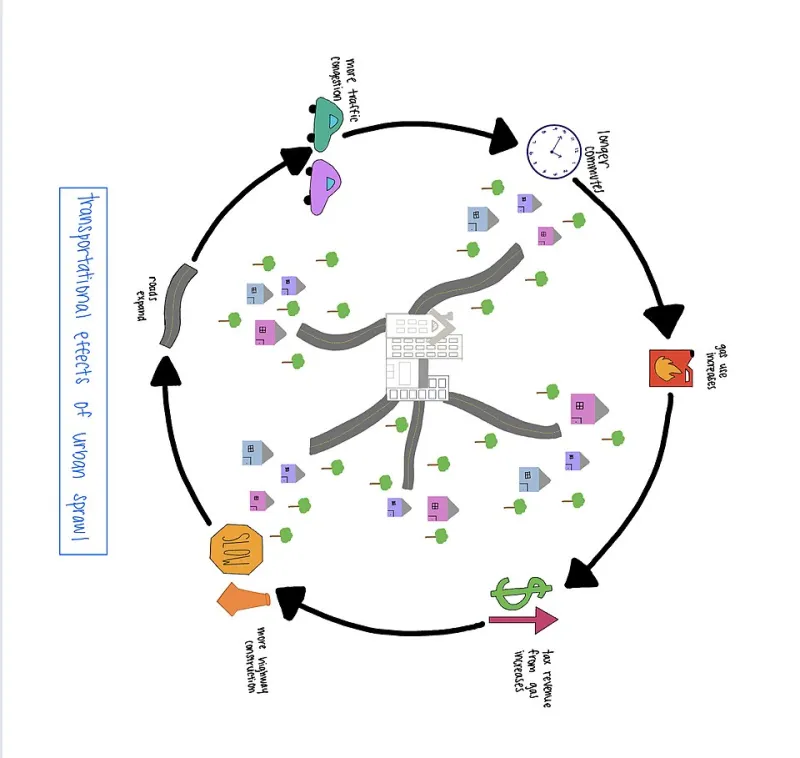
Photo: Carolinema17, CC BY-SA 4.0, via Wikimedia Commons
On a Tuesday morning in any one of thousands of American suburbs, the ritual begins before sunrise. Garage doors rise in sequence, engines turn over, and a procession of single-occupant vehicles files onto collector roads that feed arterials that feed highways. This is not a choice so much as it is a consequence—the inevitable output of a physical landscape designed, over the better part of a century, to make the personal automobile the only viable way to exist.
The transportation sector is now the single largest source of greenhouse gas emissions in the United States, accounting for roughly 28 percent of the nation's total, according to the Environmental Protection Agency. The majority of those emissions come not from freight or aviation but from personal vehicles—the cars and light trucks that Americans drive to work, to school, to the grocery store, and to the doctor. And yet framing this as a story about consumer behavior misses the more consequential story: the one about who built the roads, who wrote the zoning codes, and who decided that American prosperity would be measured in square footage and highway miles.
The Architecture of Dependency
Suburban sprawl as Americans know it today is not an accident of geography or culture. It is the product of deliberate policy decisions layered across decades. The Federal-Aid Highway Act of 1956 committed billions of dollars to the Interstate Highway System, effectively subsidizing car-based development at a scale that no market signal could replicate. Simultaneously, single-use zoning—the separation of residential neighborhoods from commercial districts, schools, and workplaces—became the dominant planning paradigm across the country.
The result was a built environment in which walking or cycling to most destinations became not merely inconvenient but physically impossible. Cul-de-sacs terminate in dead ends. Strip malls are surrounded by acres of surface parking. Sidewalks, where they exist at all, lead nowhere pedestrians actually need to go. The distances between the places where Americans live and the places where they work, shop, and seek services are, in millions of communities, simply too great to traverse without a motor vehicle.
This is what planners and transportation researchers call induced demand operating in reverse: when infrastructure is built exclusively for cars, it forecloses alternatives so thoroughly that the car becomes the only rational option. The household that owns two vehicles is not necessarily expressing a preference for driving. In many cases, it is responding to an environment that offers no other means of survival.
The Climate Math That Doesn't Add Up
Consider what a suburban household would need to do to meaningfully reduce its transportation emissions without changing where it lives. It might purchase an electric vehicle—an important step, though one that still requires charging infrastructure, still consumes significant embodied energy in manufacturing, and still demands roads, parking, and all the physical infrastructure that serves the car-dependent system. It might carpool or use public transit, though in most American suburbs, transit service is either absent or so infrequent as to be impractical for consistent use. It might consolidate errands, work from home several days a week, or choose a more fuel-efficient model.
These are meaningful actions. They are also, in aggregate, insufficient to meet the scale of reduction that climate science demands. The Intergovernmental Panel on Climate Change has made clear that wealthy nations must achieve dramatic emissions cuts by mid-century. Transportation decarbonization at that pace requires not only cleaner vehicles but fewer vehicle miles traveled overall—and fewer vehicle miles traveled requires a fundamentally different relationship between where people live and where they need to go.
The suburban household cannot walk to work if there is no sidewalk and the office park is twelve miles away. It cannot take the train if the nearest station requires a twenty-minute drive. It cannot ride a bike if the arterial road has no protected lane and a forty-five-mile-per-hour speed limit. These are not failures of individual will. They are failures of infrastructure and governance.
Who Pays, and Who Decides
The costs of car dependency are not distributed equally. Lower-income suburban households—a population that has grown substantially as housing costs have pushed working families further from urban cores—often spend a disproportionate share of their income on transportation. The American Public Transportation Association has noted that households in car-dependent areas can spend 25 percent or more of their budgets on vehicle ownership and operation. Meanwhile, the environmental burden of highway expansion and vehicle emissions falls disproportionately on communities of color, which are more likely to be located near high-traffic corridors and less likely to benefit from the greenspace and walkability investments concentrated in wealthier neighborhoods.
This is a justice issue as much as a climate issue. The communities with the least political power to reshape their built environments are often the ones bearing the greatest costs of a system designed without them in mind.
What Change Would Actually Require
Breaking the cycle of car dependency is not a matter of persuading suburbanites to make better choices. It requires rewriting the underlying rules of the built environment.
Zoning reform is perhaps the most powerful lever available. Cities and states that allow—or mandate—mixed-use development, higher-density housing near transit corridors, and the integration of commercial and residential uses are already beginning to see the results. Minneapolis eliminated single-family-only zoning citywide in 2040. Oregon passed legislation requiring cities above a certain population threshold to allow duplexes and accessory dwelling units by right. These are not perfect solutions, but they represent a recognition that the zoning codes of the mid-twentieth century are incompatible with the climate imperatives of the twenty-first.
Investment in transit infrastructure must also scale dramatically. The federal Infrastructure Investment and Jobs Act of 2021 directed significant funding toward public transit, passenger rail, and active transportation—a meaningful departure from the highway-first spending patterns of previous decades. But advocates argue the amounts remain insufficient relative to the scale of the challenge, and that state-level implementation will determine whether those dollars actually reduce car dependency or simply improve the experience of driving.
Finally, land use and transportation planning must be treated as climate policy. Approving a new highway interchange or a sprawling single-use development on the urban fringe is a climate decision, even when it is not labeled as one. Requiring environmental impact assessments that account for vehicle miles traveled, lifecycle emissions, and long-term infrastructure costs would bring greater honesty to the true price of sprawl.
The Road Ahead
America did not become car-dependent overnight, and it will not become car-independent quickly. The physical infrastructure of suburbia—its roads, its housing stock, its commercial corridors—will persist for decades. The transition will be uneven, contested, and incomplete in many places for a long time.
But the frame matters. When car dependency is understood as a structural condition rather than a personal failing, the policy solutions become clearer and the responsibility shifts to where it more appropriately belongs: to the legislators who write zoning codes, the planners who approve subdivisions, the transportation agencies that allocate highway dollars, and the elected officials who decide what kind of places American communities are allowed to become.
The commute that begins in the garage every morning is, in a very real sense, the product of decisions made in city halls and state capitals long before the current driver was born. Changing its destination requires changing those decisions—and recognizing that the climate future America needs cannot be built on a foundation designed exclusively for the car.