The All-Night Aisle: What Round-the-Clock Retail Is Costing the Climate
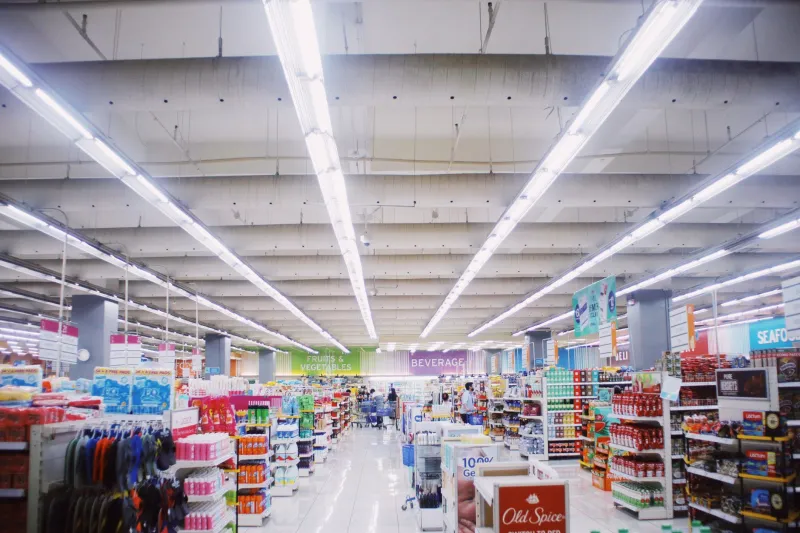
At 1:47 a.m. on a Tuesday, somewhere in suburban America, a delivery truck backs into the loading dock of a supermarket that never closes. Inside, fluorescent lights blaze across empty aisles. Refrigeration units hum without pause. A skeleton crew restocks shelves that serve, at that hour, a handful of customers. The scene feels unremarkable — even reassuring, in the way that abundance often does. But behind the convenience of the perpetually open grocery store lies an energy equation that deserves far more public attention than it currently receives.
The United States is home to roughly 21,000 supermarkets operating on extended or fully 24-hour schedules, according to industry data. That number does not account for the thousands of convenience stores, big-box retailers, and pharmacies that similarly maintain overnight operations. Together, they represent one of the most energy-intensive, yet least examined, contributors to America's commercial carbon footprint.
The Energy Burden of Keeping the Lights On
Grocery retail is, by its nature, an extraordinarily power-hungry enterprise. Refrigeration alone accounts for more than half of a typical supermarket's total energy consumption. Add commercial lighting, HVAC systems, electronic point-of-sale infrastructure, and back-office equipment, and the average American supermarket consumes somewhere between 1.5 and 2.5 million kilowatt-hours of electricity annually — roughly the equivalent of powering 150 to 200 average U.S. homes for an entire year.
What makes 24-hour operations particularly costly from a climate perspective is not simply the volume of energy used, but when it is used. Overnight demand in most retail environments remains relatively flat in terms of customer traffic, yet the physical infrastructure — lighting, refrigeration, climate control — cannot be meaningfully scaled back during low-traffic hours without significant capital investment in smart systems. Most stores, particularly older ones, run at near-full capacity regardless of whether 300 customers or 3 customers walk through the door.
This creates what energy analysts sometimes call a "baseload inefficiency" — energy expenditure that is structurally decoupled from actual need. On the grid level, overnight commercial demand in regions with limited renewable storage capacity is frequently met by natural gas peaker plants or other fossil fuel sources, compounding the emissions picture.
Supply Chains That Never Sleep — and Never Rest
The carbon calculus of round-the-clock retail extends well beyond the store's four walls. Continuous operations require continuous restocking, and that restocking depends on a logistics network calibrated to perpetual motion.
Overnight delivery windows — long favored by major grocery chains because they minimize disruption to daytime shoppers — mean that diesel-powered trucks are dispatched during hours when traffic is light but when route consolidation is also less practical. Fewer stops per run, longer distances between distribution hubs and store locations, and the operational demands of nighttime logistics all contribute to a per-unit emissions profile that frequently exceeds what daytime delivery networks achieve.
Food waste compounds the problem. Stores operating continuously face a structural incentive to maintain full shelf presentation at all hours — a standard that generates significant spoilage, particularly in fresh produce, dairy, and prepared foods. The USDA estimates that American supermarkets discard somewhere between 8 and 10 percent of their perishable inventory. A meaningful share of that waste is attributable not to demand shortfalls but to appearance standards maintained for customers who may never arrive during the hours those standards are enforced.
When food is wasted, so is every unit of energy embedded in its production, refrigeration, and transport. The climate cost of a discarded head of lettuce is not merely the lettuce itself — it is the irrigation water, the agricultural fuel, the cold chain electricity, and the eventual methane emissions from landfill decomposition.
The Consumer Side of the Equation
It would be incomplete to focus exclusively on retailers without examining the demand patterns that sustain 24-hour operations. Late-night grocery runs are, for many Americans, a product of schedule fragmentation — the reality of shift work, non-traditional employment hours, and the general erosion of structured daily rhythms that has accelerated over the past two decades.
For workers in healthcare, transportation, manufacturing, and the service economy, overnight shopping is not a preference but a necessity. Any honest policy conversation about the environmental costs of round-the-clock retail must grapple with this dimension. Reducing late-night retail hours without addressing the underlying labor conditions that create demand for them would be both ineffective and inequitable.
Nevertheless, data consistently show that a significant portion of late-night grocery traffic is discretionary — impulse-driven visits by consumers who have access to daytime shopping windows but choose convenience over intentionality. This segment represents a genuine opportunity for behavioral change, particularly as awareness of retail energy consumption grows.
What Intentional Shopping Windows Could Achieve
Several European nations offer instructive precedents. Germany's retail hours, governed by the Ladenschlussgesetz (store closing law) and its subsequent reforms, have historically limited Sunday and late-night commercial operations. While the American cultural and regulatory context differs substantially, the underlying principle — that structured shopping windows reduce systemic energy waste — has measurable empirical support.
Domestic research on demand-side energy management suggests that even modest reductions in overnight commercial operating hours could produce significant grid-level benefits, particularly in regions where renewable energy storage remains underdeveloped. A supermarket that closes between 1 a.m. and 6 a.m. — or that transitions to a reduced-capacity overnight mode with intelligent refrigeration cycling and dimmed lighting — could cut its daily energy consumption by an estimated 15 to 25 percent, depending on existing infrastructure.
Retailers themselves have begun to explore this territory, though often for financial rather than environmental reasons. Several major chains reduced overnight hours during the COVID-19 pandemic and reported energy savings significant enough to prompt permanent adjustments at select locations. The climate case for those adjustments deserves to be made as explicitly as the financial one.
Rethinking Convenience as a Climate Value
Convenience is not inherently incompatible with sustainability. But the version of convenience that America's retail infrastructure currently offers — unlimited access, at all hours, to fully stocked, fully illuminated, fully climate-controlled shopping environments — carries an environmental price tag that is rarely itemized at the checkout.
For consumers, the most immediate action available is also the simplest: consolidating shopping trips, planning purchases in advance, and reducing the frequency of discretionary late-night visits. These choices reduce personal transportation emissions, decrease household food waste, and — in aggregate — diminish the demand signals that sustain energy-intensive overnight retail operations.
For policymakers, the opportunity lies in incentive structures: utility rate designs that discourage overnight commercial energy use, food waste reduction mandates that remove the spoilage incentives embedded in full-shelf standards, and supply chain regulations that reward route consolidation and emissions efficiency.
The grocery store that never closes has become a symbol of American abundance. It may be time to examine what that symbol is actually costing — not just in dollars, but in degrees.